What your diagnosis means — why only one constraint
Last updated: 1 August 2026
Paceloop names exactly one lever as the thing capping your store this cycle, and shows the number behind it. Not a ranked list of problems, not five things to improve — one constraint, because a plan that works three levers works none of them. Everything your plan does for the next four weeks is aimed at that one thing.
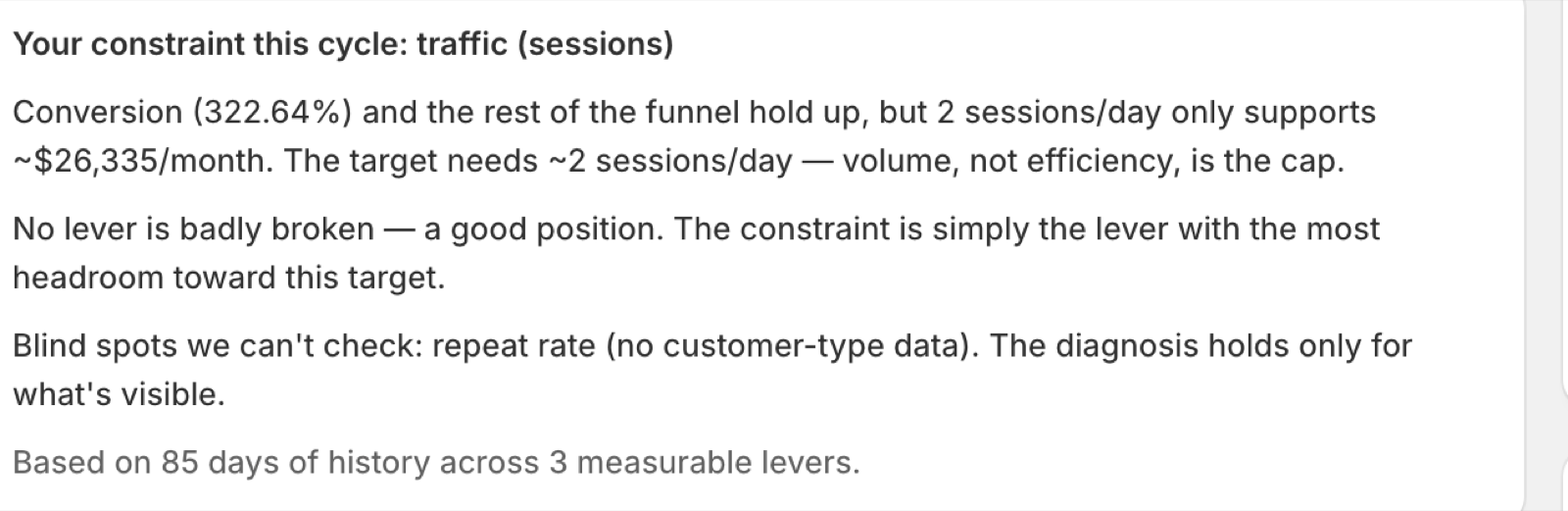
The headline reads "Your constraint this cycle: [the lever]", followed by the evidence, anything Paceloop couldn't check, and what the read is based on.
The five levers
There are only five things Paceloop will ever name: "Traffic (sessions)", "Conversion rate", "Average order value", "Repeat purchase rate", and "Gross margin / product mix". Every diagnosis is one of those, or an honest refusal to pick.
What it compares you against
Three broad DTC medians, used as reference points and described as exactly that — not as your industry's numbers, not as a benchmark you're being graded by:
- conversion rate around 1.4%
- repeat order share around 25%
- catalog gross margin around 55%
A lever's score is how far below its reference point it sits, relative to that reference point. Margin carries slightly more weight than the others, because a margin problem compounds: growing revenue on thin margin scales losses, not profit.
How the winner is picked
Levers that can't move your goal are removed before anything is scored. So a lever can never win a goal it has no mechanical effect on. Those levers are reported honestly as "not a driver of this goal" — explicitly not the same as being ruled out on the numbers.
Traffic is scored only if the funnel behind it holds water. If conversion is below its healthy band, traffic scores zero however thin your traffic is. More visitors into a leaking funnel is a more expensive leak — the rule behind why Paceloop won't send more traffic to a leaky funnel.
If nothing is meaningfully weak, Paceloop says so rather than manufacturing a problem:
"No lever is badly broken — a good position. The constraint is simply the lever with the most headroom toward this target."
That is a real outcome, not a fallback apology. The constraint in that case is the lever with the most room to move toward this specific target.
Why not the others
Under the headline sits "Why not the others" — one line per lever explaining why it lost. The wording distinguishes two different verdicts, and the difference matters:
- Ruled out on the numbers — for example, "[your rate] is at or above the ~1.4% median — not the binding constraint."
- Not applicable — "[the lever] can't move [your metric] — not ruled out, just not a driver of this goal."
The first is evidence. The second is scope. Paceloop won't dress one up as the other.
Blind spots
Anything relevant that Paceloop couldn't read is named out loud, not quietly dropped:
"Blind spots we can't check: [the unreadable levers]. The diagnosis holds only for what's visible."
The listed items are specific about the cause — "repeat rate (no customer-type data)", "traffic & conversion (no session data)", "margin (cost-per-item missing)". A diagnosis with a blind spot is still useful; a diagnosis that hides one isn't. See what "Not readable" means for what unlocks each.
The confidence badge
Next to the diagnosis, "Confidence: high", "medium" or "low", with the reason underneath — for example, "Based on 85 days of history across 3 measurable levers." Confidence is high when at least three levers are measurable, and low whenever your underlying history is thin, regardless of how clean the winner looked. Thin history gets its own line: "Thin history — revisit this diagnosis after a few weeks of data."
When it refuses to diagnose
With no orders in the window, or with too few readable levers to compare, Paceloop doesn't guess:
"Not enough data to name your constraint — and we won't guess" — "A wrong diagnosis is worse than a delayed one. The plan below focuses on making the store measurable first."
You still get a cycle and a plan. The plan just works on making your store readable, which is the only honest first move.
When your goal is already a lever
If your cycle goal is one of the five levers — say your objective is conversion rate itself — there is nothing to diagnose. Paceloop says so: "Your goal targets [the metric] directly", noted as "Structural, not scored: a direct-lever goal is its own diagnosis." The plan then works that lever directly, because that's what the goal is.
Where the diagnosis follows you
It's shown when you pick your plan, kept on the cycle page for the rest of the cycle, and summarised on your scoreboard as the "Constraint" card — labelled "The one lever this cycle's plan works." One constraint, one plan, one number, for four weeks.
Related: where your plan's behaviors come from · how to read your pace scoreboard · set up Paceloop from scratch